
AI Agents Explained: How They Differ From Traditional AI Chatbots
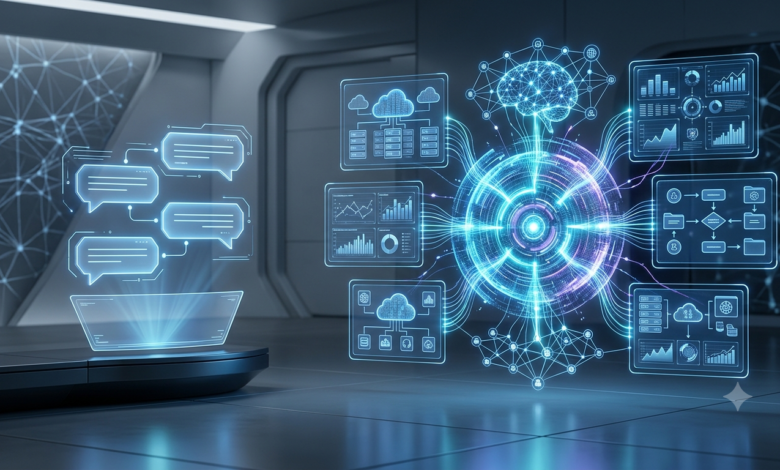
Artificial intelligence is moving beyond answering questions and generating text. A growing class of AI systems can use tools, follow multi-step workflows, retrieve information from different sources and carry out tasks with varying levels of independence. These systems are commonly known as AI agents.
For businesses and consumers in France, understanding the difference between AI agents and traditional AI chatbots is becoming increasingly useful. A chatbot might explain how to prepare a sales report, for example, while a suitably configured AI agent could retrieve approved business data, analyse the results and prepare a draft report for review.
The distinction is not always absolute. Modern chatbots can also use tools, and not every system marketed as an agent can act independently. The important difference is how a system is designed to pursue a goal, interact with other software and manage a sequence of actions.
What Is an AI Agent?
An AI agent is a software system that uses an AI model, instructions and, where needed, tools or external services to work towards a defined objective. Depending on its configuration, it may decide which steps to take, gather information, perform actions, assess the results and continue until it reaches a stopping point or needs human input.
Unlike a simple question-and-answer interaction, an agent can be designed to handle a task that involves several connected operations.
For example, a business might ask an AI agent to review customer feedback from an approved database, group recurring complaints, identify common themes and prepare a summary for the customer service team. The agent could use database access and analysis tools to complete those steps rather than merely explaining how an employee could do them.
AI agents vary considerably in their capabilities. Some follow predefined workflows, while others select tools and adapt their approach as they work. More advanced systems can hand tasks to specialist agents or operate within a controlled software environment.
How Traditional AI Chatbots Work
Traditional AI chatbots are designed primarily to communicate with users through conversation. They receive a question or instruction and generate a relevant response using their training, the conversation context and any information made available to them.
Common uses include:
-
Answering questions and explaining technical concepts.
-
Drafting emails, articles and reports.
-
Summarising documents.
-
Translating text between languages.
-
Brainstorming ideas and helping users solve problems.
For example, a user could ask a chatbot to create a marketing plan for a small business in France. The chatbot might produce a structured plan containing audience research suggestions, campaign ideas and proposed performance indicators.
However, unless the system has the appropriate tools and permissions, it will not necessarily collect live market data, update the company’s customer relationship management system or schedule campaigns.
This does not mean traditional chatbots are incapable of taking action. Modern conversational AI products can browse, retrieve information and call external tools. The distinction is between a system designed mainly to respond and one configured to manage a broader task-oriented workflow.
How AI Agents Work
Although implementations differ, an AI agent often follows a sequence of steps to complete a task.
1. Receive a goal
Understand the requested outcome and applicable constraints.
2. Plan the work
Determine the steps, information and tools needed.
3. Use permitted tools
Search approved sources, analyse data or interact with connected software.
4. Check the result
Evaluate the output, correct problems where possible or request human input.
5. Deliver or stop
Return the result, request approval or stop when a defined condition is reached.
Illustrative workflow. Actual agent systems may use fewer steps, repeat actions or follow predefined procedures.
Tools are what make many agent workflows especially useful. Depending on their configuration, agents can access search services, business databases, APIs, document repositories, code execution environments or computer interfaces. Their access should be limited to what the task requires.
OpenAI’s agent documentation describes this approach through model instructions, tools, execution loops and safeguards. Google Cloud also documents agent platforms designed to connect AI systems to enterprise workflows and information.
